Showing posts with label transport. Show all posts

Friday, 1 May 2015

The government needs to do more to improve transport in Cornwall

“What can be done to improve transport links to and from Cornwall 
as well as transport within the county?”

Transport links in Cornwall are not ideal and I’m glad the question addresses the vital issue of getting 

around Cornwall not just getting up country. Fundamentally one of the key issues for our next MP 

should be getting fair funding for our transport network and to get the crucial decisions devolved to 

Cornwall, as we know best the problems we face and how to solve them and this is true not just for 

roads but also public transport including of course the links with the Isles of Scilly. 


Recently the  government was unwilling to pay for A30 improvements, despite the fact they are responsible 

for it, Cornwall Council is contributing. This is an unwelcome development as we in Cornwall and tourists, 

pay road tax to central government, where is this money going? We need some of Cornish taxpayers 

money back from the Treasury to pay for transport. 


We need to rethink how we deliver it and should  seriously consider renationalising the public transport 

network that we already subsidise and look to improving it by making train and bus times schedules in 

relation to each other. We need well-funded  public transport that is quick, efficient and doesn’t costs 

travellers the earth to travel.

Saturday, 19 July 2014

The silliness of painting lines over the Hayle A30 roundabout problem

You may have missed it whilst driving but the Loggan's Moor roundabout has had the 'Chivvy treatment' and the problem of congestion met with subtle reorganisation. Now at the cost of £200,000 there have been lines painted demarcating where drivers should be when negotiating the roundabout. As the Highways Agency explained:

What are the benefits?

The scheme improvements will result in improved flow through the junction by increasing it's traffic capacity and improving identification of traffic routes and so reducing waiting times, especially during peak tourist times. The proposals achieve wider benefits in supporting growth in the surrounding area, such as development at Hayle.

I was waiting with baited breath to see how much this did change things and has so far only been through at less than peak travel hours and found not a great deal of difference. Sure not being cut up at the roundabout was a good thing but when I'd driven round, it wasn't busy so wouldn't have been a problem anyway.

Then on thursday I had to drive up to St Dennis from Penzance, late at night on the way back I was treated to the awesome thunder and lightning show, which was truly breath taking, the trip up there was not so breath taking. Leaving here at 6 in the evening I thought that even with it being the summer, it would be late enough to ensure a fairly smooth drive and I was truly wrong. Passing Sainsbury's wasn't a great problem, it seems like such a small amount of cars that turn off to the store is there a point of yet another roundabout on our supposed trunk road?

But anyway, Crowlas was at a standstill and the traffic crawled along until the Hayle bypass. There it opened up until it went back to a single lane and traffic was queuing on the corner before the viaduct all the way to the roundabout. Notwithstanding the possibility that there was an unusual amount of traffic going past Hayle at quarter past 6, I've never been in the queue so far up. The other side it was the same old same old, traffic queuing up to the Roseworthy Dip (or big dipper is you prefer). So west bound and east bound there was the queuing that there has become so common. As most motorists in West Cornwall had feared a few lines on the tarmac had not solved the problem at all. Hundreds of motorists all bottlenecked to the same location, inevitably have to stop or slow at a roundabout causing congestion.

The journey continued in a similar vein slow up to Chivvy, slow after than at a standstill after the short section of dual carriageway (or 2 lanes for pedants) at Zelah. Crawling towards Carland Cross, funnily enough not the same problems afterwards on the dual carriageway without roundabouts!

As many of us know the powers that be are planning an increase in the rate of house building up until 2030. There already concerns being raised in the west that this will lead to gridlock especially in places like Ludgvan, Crowlas, Carbis Bay and Lelant which have traffic problems already. With public transport on the slide, becoming less and less of a priority for the government and Cornwall Council problems looks set to get worse as road use inevitably rises.

The other cause for concern is the importance of roads to the Cornish economy. The Highway's Agency cites tourism and no doubt this is an issue the population of Cornwall this time of year massively increases and thus the number of vehicles. There is always a danger people will choose to holiday elsewhere if they spend too long travelling and stuck in traffic.

But of course tourism is not the be all and end all and unbeknownst to most decision makers outside Cornwall there is life in Cornwall outside the summer. The other reason given is population growth ignoring the fact that the problem exists now, let alone with tens of thousands of new homes in West Cornwall. Lots of people commute to work/ education and training in Cornwall especially along the A30 corridor. Delivery, logistics and the odd tractor travelling within Cornwall rely upon our trunk road. In addition a massive part of the Cornish economy is the food and food production industry, which has a huge export market. With a huge amount of Cornish produce, fish, meat, veg, milk, clotted cream etc being exported to England. That's not even to mention all of the other industries that export and import along the A30. What is the impact on people's lives constantly queuing to go to work and college? What is the cost to freight companies to have lorries sat in queues? How could productivity be increased and the Cornish economy grow if employees and assets spent less time sat in traffic?

It comes to a stage where the wider economic impact of having poor connection links within Cornwall and with the wider world needs to be addressed, whether through building bigger capacity roads or diversifying and making rail travel or bus travel more attractive. What is clear though is that painting lines on a roundabout doesn't address the problem and it never will. The attitude of government whether through the Highway's Agency or other departments is guided by the treasury and is not about what it best for Cornwall and our economy and quality of life but what is cheapest. With the occasional sticking plaster added with more fanfare than real purpose...

Friday, 4 July 2014

Glass half full and half empty, some thoughts on the big rail news

I think in this world there are pessimists and optimists but there is also the majority of us between those two poles optimistic about some things and pessimistic about others. I find myself firmly in this category with this announcement. I don't mean to pour scorn on the massive investment, it is a really good thing but my view is tempered by what we are not getting. Perhaps I want too much from our politicians and I'll never be happy?


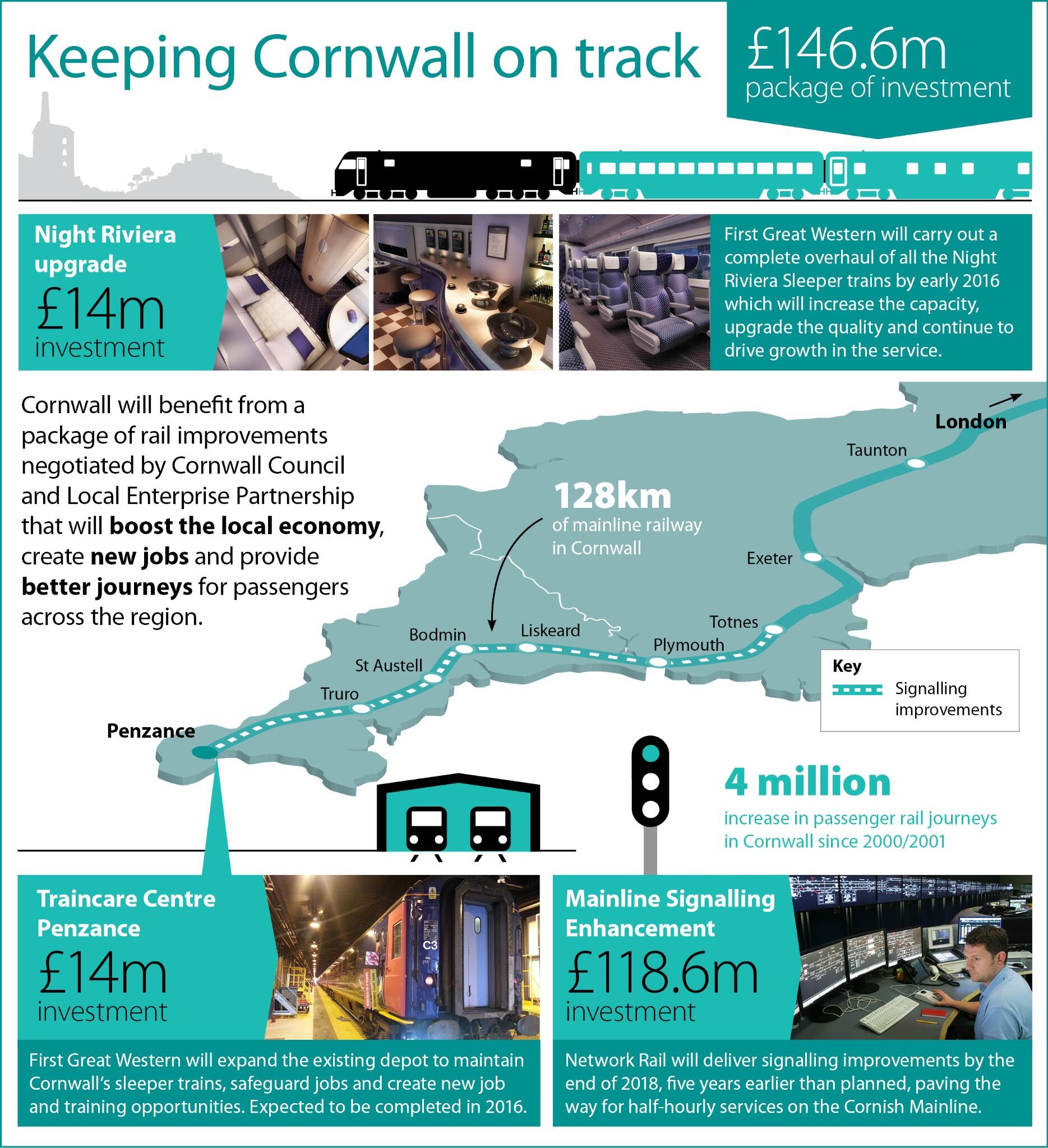
In that vein I'll sandwich the sections of this blog with the optimistic, pessimistic and end with some optimism. My sort of compliment sandwich for the government. Firstly the really good news there will be a new 'train care center' at Penzance (or Long Rock to be more geographically correct) the present yard will be extended. There will be 60 new jobs created there. This situation has come about as the Old Oak Common train maintenance depot is closing in it's present form as part of the High Speed 2 works. Apparently the present staff will be redeployed on HS2 not relocated to Cornwall. Quite where the new workers will come from is not at the moment clear and as with lots of this what actually comes into being will not be clear until it happens. (to let my pessimism impinge a second). There is already talk of tying up education and training locally to meet this new demand. Details aside, this is brilliant news and I can't complain at it, because I would be a massive hypocrite. Time and again I have argued that we need good quality jobs in Cornwall and that industry is the key to this not simply tourism. Similarly I can not complain about the government investing in Cornwall nor Cornwall Council and the LEP investing in the west. On both counts brilliant news.

However signalling is a useful transition from the positive to the negative. It again is good news, the modernisation of the signalling system from Totnes west is long overdue. The electrification of the system will allow for more trains and for them to travel faster equaling shorter journey times and more trains and unleashing the potential of the current network. But much like so much since the advent of industrialisation, these machines as efficient and effective as they are mean less workers. I'm by no means about to out myself as a modern day Luddite, but we do have to temper the amount of new jobs as part of the Long Rock traincare center with the 40 jobs now redundant and I'd imagine the new staff that will tend the computers, will do so from outside Cornwall.

Signalling -and the reason why it is so critical in Cornwall- tells us a great deal about the ageing infrastructure of rail in Cornwall. The actual trains and how they run on the network here takes a great deal of planning and management due to two problems the amount of single track and viaducts and a combination of the two. This obviously impedes the effectiveness of the main line as trains can't pass each other and it's fairly uncommon as I understand for all but branch-lines in the UK to not be dualled.

The government is spending a large amount of money on rail travel. The obvious big ticket item (or huge ticket) is HS2 but there is also a large number of projects elsewhere. The East Coast mainline modernisation and a whole host of places will soon be served by electric trains which is a more modern method widespread on the continent as it's more fuel efficient, thus cheaper and greener to run. Dawlish, what can be said? It very much looks like there will not be a bypass there. It looks to me a bit of a trade off, we don't get a resilient storm proof trainline, but we do get signal enhancements and maintenance jobs. If so it's a risky strategy by the government gambling that the works done will safeguard the main line between Penzance and Paddington or we won;t suffer such heavy storms. I suppose what I'm getting at is that if we were to have a truly modern rail line in Cornwall, it would be dualled, storm proof and electrified. Be cheaper to run, better for the environment and quicker.

To end on a high note, the backstory to the good news especially for Penzance and West Cornwall is that it stops a number of things happening. Firstly rumours, speculation and plans that the sleeper service to London will be greatly reduced or axed altogether, will not happen. Secondly that Penzance might no longer be on the mainline and Truro be the final destination cutting off Redruth, Camborne, Hayle and St Erth as well, will not happen. Thirdly there is always the possibility that the shoreline from Eastern Green to Marazion is in danger of coastal flooding due to sea level rises or storms. There were doubts that this sea front would be defended as expressed in the Shoreline Management Plan but hopefully this now elevates the importance with the powers that be.

To conclude this is a good news, it's better than the present situation and it means things will positively happen and that some bad things can't happen. But as the title suggests the glass is both half full and half empty. We're far from an ideal rail network in Cornwall, much like the government approach (for decades) to the A30, things slowly improve but there is a lot of tinkering around problems not addressing them head on. In that case it's redesigning roundabouts and in this case it's modern signalling but in both cases it falls short of  the more expensive dualling. In an ideal world where successive governments were eager to invest in Cornwall perhaps we'd have these things but this is not an ideal world and perhaps this time we should be grateful that things are improving and not getting worse.

Credit to the various people that have made this deal happen, to be honest I'm not sure who came up with the idea. Heard various people take credit and give credit to others for it, I'd imagine it was a team effort, but unlike the word team there is a big I in politician.